


October 06, 2026
Article
As electric vehicles become increasingly common across farms, estates and rural businesses, it is important to consider the most tax-efficient way to obtain relief for both running costs and vehicle purchases.
PRIVATE CARS
Where a sole trader, partner or director uses their own car for business journeys, HMRC allows tax relief using its approved mileage rates.
From 6 April 2026, the rate increased from 45p to 55p per mile for the first 10,000 business miles, with 25p per mile applying thereafter. This represents the first increase since 2011.
The rates apply regardless of whether the vehicle is electric, petrol or diesel powered and are intended to cover all motoring costs, including:
- Fuel or electricity
- Repairs and servicing
- Insurance
- Road tax
- Depreciation
For electric vehicles, the actual charging cost is often significantly less than 55p per mile, making this a potentially attractive and simple option.
BUSINESS OWNED VEHICLES
Businesses purchasing electric vehicles can benefit from favourable capital allowance reliefs.
A 100% First Year Allowance (FYA) remains available for new and unused zero-emission cars, allowing the initial cost to be relieved in the year of purchase.
Where there is private use, sole traders and partnerships can only claim relief on the business-use proportion of the cost. For example, a £40,000 electric car with 75% business use would generate tax relief of £30,000.
Second-hand electric cars do not qualify for the FYA but can qualify for Writing Down Allowances (WDA’s), for 2026/27:
- Cars emitting 50g/km of CO² or less qualify for a 14% WDA’s.
- Cars emitting more than 50g/km of CO² qualify for a 6% WDA’s.
Businesses can also claim 100% relief on qualifying charging infrastructure installed at farms, estates and other business premises.
However, where the vehicle is owned by the business, running costs such as electricity, insurance and repairs must also be apportioned between business and private use, making record keeping particularly important.
COMPANY CARS AND BENEFIT-IN-KIND
Where a company provides an electric car to a director or employee and private use is permitted, a Benefit-in-Kind (BIK) charge arises.
The rates for fully electric cars are:
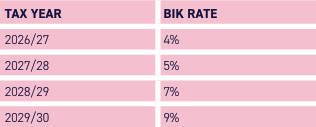
These rates remain significantly lower than the 25% to 37% BIK rates applying to petrol and diesel cars dependent on their emissions.
For example, an electric company car with a list price of £40,000 would give rise to a taxable benefit of £1,600 in 2026/27 (4% × £40,000).
The company must also pay Class 1A National Insurance on the taxable benefit at 15%.
WHICH OPTION IS BEST?
There is no one-size-fits-all answer. Where business mileage is high and charging costs are relatively low, claiming the 55p mileage rate can be surprisingly tax efficient. Conversely, businesses purchasing a new electric vehicle with predominantly business use may benefit more from the immediate tax relief available through the 100% First Year Allowance. Reviewing both options before purchase can help ensure the most tax-efficient outcome.