


July 15, 2026
Article
Inheritance Tax will apply to “unused pensions” on deaths occurring on or after 6 April 2027.
This change is set to reshape the retirement and estate planning. Since 2015, it’s made sense for people with an IHT problem to build up their defined contribution pension, leaving it untouched for long as possible to treat it as a legacy asset. Leaving the pension pot until “last” meant it could potentially be passed on death free of IHT and tax efficiently to beneficiaries.
The Finance Act 2026 has received Royal Assent, so from 6 April 2027 it’s no longer tax efficient to use a defined contribution pension pots as an inheritance tax-planning vehicle. Saving in a pension is still the most tax-efficient way to save for your retirement income needs, but a pension won’t be as inheritance efficient.
Scope of the new framework
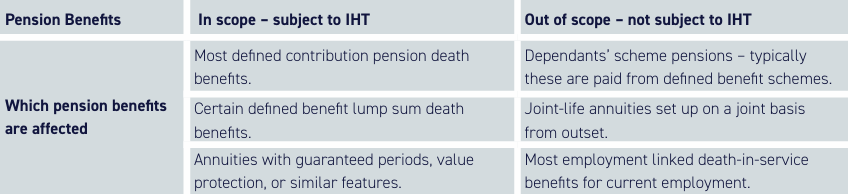
Below is a summary of what’s affected by the new farmwork in terms of benefits and beneficiaries
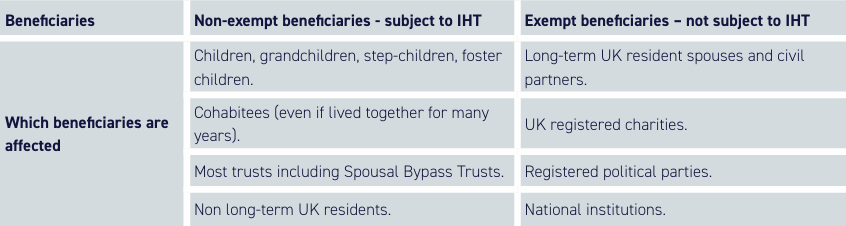
There is a distinction between exempt and non-exempt beneficiaries. Transfer of death benefits to spouses, civil partners and qualifying charities will remain free of IHT. Transfers of death benefits (above the available nil rate band) to children, grandchildren, cohabitees and trusts will not.
One consequence of the new rules is the risk of double taxation where death occurs from age 75, as income tax also applies to withdrawals taken out by the beneficiaries. The majority of people (7 in 10) are likely to die AFTER age 75 but 3 in 10 people will die before age 75, so it’s important not to delay seeking advice.
Death Benefits Nomination
Who receives your pension benefits on your death isn’t covered by your will. You need to complete an “Expression of Wish”, which tells your pension scheme provider who you wish to leave your pension pot to on your death. Without one, the Pension Scheme trustees must investigate who your beneficiaries are and may require Grant of Probate or Letters of Administration before releasing funds, causing delays to the payout.
Without a named beneficiary, the trustees may be forced to pay out a one-off lump sum to a beneficiary instead of keeping the funds in the pension pot for the beneficiary to take regular pension withdrawals (beneficiary drawdown) which can be more tax-efficient. Not all pension scheme rules allow beneficiary drawdown.
An Expression of Wish isn’t strictly legally binding, but it’s a guide trustees use and you can update it anytime. Whilst your beneficiaries can use a legal process known as a Deed of Variation, to vary who benefits from your Will after your death, it can’t be used to vary how the pension benefits are paid out after your death.
This shift in IHT rules means that it’s 1) who you nominate on an Expression of Wish as well as 2) the specific rules of your Pension Schemes, that have direct tax consequences.
Please get in touch with us to discuss how the new IHT rules might impact on you and your beneficiaries and the options available to minimise the impact.
This content is for information only and does not constitute advice.A pension is a long-term investment not normally accessible until age 55 (57 from April 2028 unless the plan has a protected pension age). The value of your investments (and any income from them) can go down as well as up which would have an impact on the level of pension benefits available.